Budget 2026 Capital Allowances Update: The 50% FYA, WDA Rate Cuts, and Pre-Development Cost Update

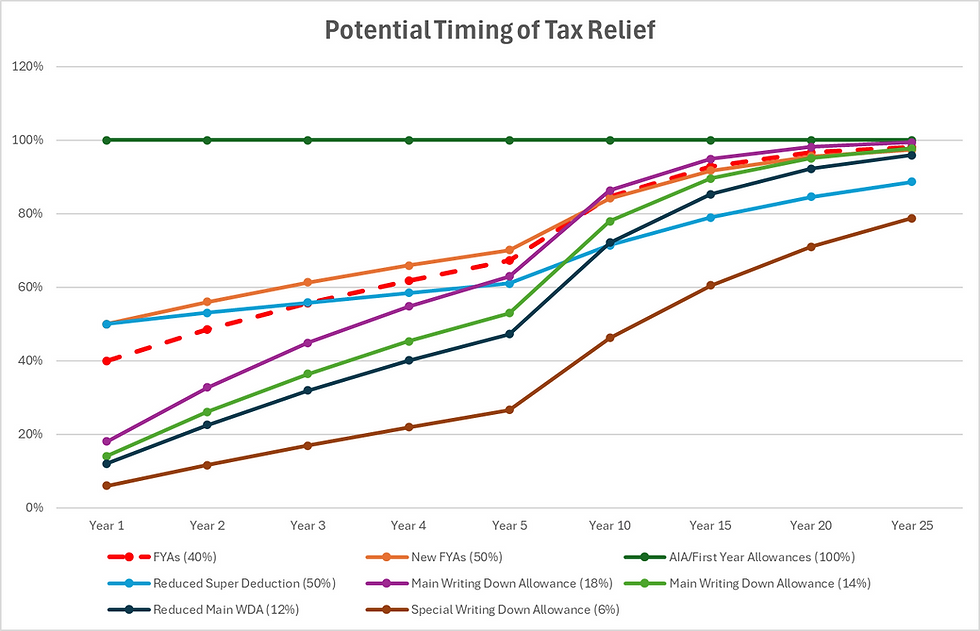
Budget 2026 announced further headline changes to the UK’s capital allowances regime. For corporate tax practitioners, finance directors, and property investors, the latest package represents a double-edged adjustment: the 40% First-Year Allowance (FYA) introduced from January 2026 will increase to 50% from January 2027, balanced by a further reduction in the main rate writing down allowance (WDA) to 12% (which has now moved from 18% to 14% to 12% since Budget 2025).
When combined, these rate changes are expected to net HM Treasury £4bn+ over the next 5yrs reaching approximately £1.1bn annually towards the end of the forecast period. Today’s Budget also contained more information on the ongoing treatment of ‘Pre-development Cost’, details of where capital allowances sit within a new overarching consultation on ‘Corporate Tax Simplification for Business Investment’, some targeted leasing anti-avoidance and a welcome reduction to the threshold for ‘Advance Tax Certainty’ for major projects.
Key Capital Allowances Announcements at Budget 2026
The government announced that it will introduce legislation in Finance Bill 2026–27 to increase the main rate First-Year Allowance to 50% for qualifying expenditure incurred on or after 1 January 2027. This represents an acceleration from the 40% FYA introduced at Budget 2025 (which applied to expenditure from 1 January 2026). The enhanced FYA applies across both Corporation Tax and Income Tax regimes, maintaining the extended eligibility for plant or machinery acquired for leasing.
To balance the fiscal cost of accelerated first-year allowances, the main rate Writing-Down Allowance for general pool assets will be reduced from 14% to 12%. This reduction takes effect from 1 April 2027 for Corporation Tax and 6 April 2027 for Income Tax. This follows the previous reduction from 18% to 14% enacted in the prior year's Budget.
Targeted Anti-Avoidance & Administration Measures
Leasing Anti-Avoidance (s228G CAA 2001): Legislation in Finance Bill 2026–27 expands the statutory definition of a finance lease specifically as applied to lease and leaseback arrangements under Section 228G of the Capital Allowances Act 2001. This restores the policy’s intended reach to relevant lessees whether they hold a formal finance lease or a relevant right-of-use lease, taking effect from 28 October 2026.
Advance Tax Certainty Service (ATCS) Threshold Drop: Following its initial rollout for major projects, the entry threshold for the Advance Tax Certainty Service has been significantly lowered from £1 billion to £300 million for qualifying investment projects, taking effect from 4 November 2026. This allows a broader range of large-scale capital projects to secure binding clearance from HMRC on complex tax treatments prior to committing capital.
Timing of Tax Relief and Cash Flow Comparison
The interplay between accelerated first-year relief and reduced writing-down rates creates distinct tax cash flow profiles depending on the allowance claimed. On a baseline £1,000,000 qualifying capital expenditure incurred by a company paying Corporation Tax at 25%, the cumulative tax savings vary substantially across the different statutory mechanisms over a three-year horizon.
Cumulative Potential Tax Savings on £1,000,000 Main Rate Capex (25% CT Rate):
Claim Mechanism | Year 1 Tax Relief | Year 1 Tax Saving | Year 2 Cumulative Saving | Year 3 Cumulative Saving |
100% Full Expensing / AIA | £1,000,000 | £250,000 | £250,000 | £250,000 |
New 50% FYA (Budget 2026) | £500,000 | £125,000 | £140,000 | £153,200 |
40% FYA (Budget 2025) | £400,000 | £100,000 | £121,000 | £139,060 |
Legacy 18% WDA | £180,000 | £45,000 | £81,900 | £112,158 |
Interim 14% WDA | £140,000 | £35,000 | £65,100 | £90,986 |
Reduced 12% WDA (Budget 2026) | £120,000 | £30,000 | £56,400 | £79,632 |
The policy costings published alongside the measures confirm that reducing the main rate WDA to 12% generates net positive Exchequer revenue in medium-term tax years (+£125m in 2026–27, rising to +£765m in 2027–28 and over +£1bn annually thereafter), offsetting the
initial cost of the 50% FYA. Consequently, businesses that do not qualify for or choose not to claim accelerated First-Year Allowances or AIA will experience slower capital recovery under the 12% writing-down rate.
Pre-Development Costs: Next Steps
Alongside rate adjustments, Budget 2026 published the government's official Summary of Responses to the Tax Treatment of Predevelopment Costs Consultation. This consultation was initiated on 13 July 2026 following the landmark Supreme Court decision in Orsted West of Duddon Sands (UK) Ltd and others v HMRC [2026]. Furasta was actively involved in the consultation with other stakeholders and a copy of our response can be found below.
As well as a commitment to clearer guidance with more worked examples on the tax treatment of pre-development costs, there is an explicit integration of pre-development cost relief into the government’s wider consultation paper announced today ‘Corporate Tax Simplification for Business Investment’ so this will be an important area to look out for in 2027.
This consultation includes targeted capital allowances, R&D reliefs, patent box, intangible fixed assets, controlled foreign companies, anti-hybrid rules, interest deductibility, withholding tax on overseas interest, reporting and administration – the deadline for responses is 21 November 2026.
Further capital allowances areas under review
The simplification consultation also highlights potentially broader interactions within the capital allowances framework:
Large-Scale Infrastructure & Loss Restrictions: The government is examining how capital allowances interact with the carried-forward loss restriction rules for capital-intensive infrastructure projects, where heavy early-stage allowances can generate substantial tax losses that face restriction in later profitable years.
Agricultural Infrastructure: The government is exploring targeted capital allowance support for agricultural infrastructure, including glasshouses, polytunnels, and on-farm reservoirs, balancing environmental, economic, and domestic food security objectives.
Alignment with R&D Modernisation: Pre-development cost simplification sits alongside wider administrative streamlining across corporate investment incentives, including the removal of R&D claim pre-notification forms from April 2027 and the rationalisation of Additional Information Forms (AIF) from autumn 2027.
Strategic Takeaways for Businesses and Investors
Review Capital Planning Assumptions: The reduction in main rate WDAs from 18% to 14%, and to 12% from April 2027, means businesses should revisit existing main pool tax assumptions. Deferring claims leaves expenditure to be relieved at the lower rates, potentially slowing tax recovery. Businesses should therefore review the timing and utilisation of outstanding claims in light of their taxable profits and available losses.
Maximise FYAs and AIA: Where Full Expensing (100%) or AIA (£1m at 100%) is unavailable - such as for unincorporated businesses or corporate leasing expenditure above £1m - the new 50% FYA (effective 1 January 2027) offers an important timing advantage over the 12% WDA pool rate.
Audit Pre-Development Cost Invoicing: In light of Orsted and the proposed improvements to guidance, businesses undertaking major capital projects should establish clear contractual breakdowns separating conceptual/consenting studies from detailed fabrication and installation engineering at the time expenditure is incurred.
Engage in the Simplification Process: Businesses operating in energy, infrastructure, and real estate are encouraged to participate in HMRC’s tax simplification working groups ahead of April 2027 to shape the practical apportionment rules and guidance examples.
If you have any questions or would like more information on any of the matter raised please contact bryan.crawford@furastaconsulting.com